


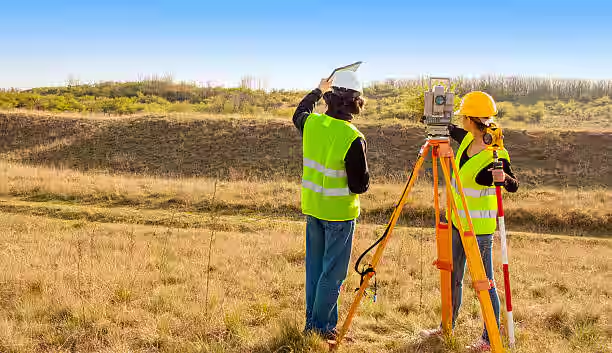

Property boundaries tell a story that often began decades or even centuries ago. Modern surveying equipment delivers remarkable precision, but technology alone cannot explain where a property legally begins or ends. Historical records provide the missing context, allowing surveyors to compare past documentation with present-day field evidence to produce accurate and legally defensible boundary determinations.
Earlier Deeds Often Reveal the Original Property Boundaries
Every property has a legal history, and earlier deeds frequently contain details that newer documents leave out. Original descriptions may reference natural landmarks, neighboring owners, monuments, distances, or directions that help a land surveyor understand how a parcel was first established. Even outdated wording can provide valuable clues during a modern property line survey.
Comparing multiple deeds often uncovers changes made over generations of ownership. Property transfers sometimes simplify descriptions without changing the legal boundary itself, making older records especially valuable when questions arise. Homeowners searching for a property surveyor near me are often surprised to learn that documents recorded decades ago still influence today’s boundary determinations.
Old Survey Plats Help Confirm Boundary Evidence in the Field
Survey plats serve as visual maps that illustrate how land was measured when previous surveys were completed. These drawings often identify monument locations, lot dimensions, adjacent properties, roads, and easements that continue to affect property ownership today. Reviewing those plats allows surveyors to compare historic information with current field conditions.
Field crews rarely depend on one source of evidence alone. Instead, they compare several references before reaching professional conclusions. Valuable information commonly found on historic plats includes:
- Monument locations and descriptions
- Original lot dimensions
- Boundary bearing and distance information
- Adjacent parcel relationships
- Easement locations
This layered approach helps confirm whether existing evidence still matches the property’s recorded history.
Historic Easements Explain Longstanding Access Across Properties
Access rights often remain attached to land long after ownership changes. Historic easements document legal permissions for driveways, utility corridors, drainage systems, or shared access routes that may not be obvious during a site visit. Without reviewing older records, surveyors could overlook important legal interests affecting the property.
Long-established easements sometimes explain why fences, roads, or utility lines cross neighboring parcels. Rather than assuming these features were placed incorrectly, a land surveyor investigates recorded documents to determine whether legal agreements support their location. Historical research provides answers that physical observations alone cannot supply.
Previous Corner Records Help Reestablish Missing Property Markers
Boundary monuments occasionally disappear because of construction, erosion, road improvements, or natural weathering. Missing markers do not erase property lines, but they do require additional investigation before replacement corners can be established accurately. Previous corner records preserve measurements and descriptions that guide modern survey work.
Professional surveyors compare surviving monuments with archived documentation to rebuild the original boundary framework. Rather than guessing where a corner once stood, they evaluate multiple sources of evidence before reaching a conclusion. People searching for surveyors near me benefit from this careful process because accurate corner recovery protects property rights for everyone involved.
Archived Right of Way Maps Clarify Roadway Boundary Locations
Roadways rarely occupy random locations. Right of way maps document land dedicated for public transportation, utility corridors, and future roadway improvements. Those records help determine where private ownership ends and public responsibility begins, particularly along highways, county roads, and municipal streets.
Understanding right of way limits becomes especially important before construction projects, fencing, or new driveways begin. Property owners sometimes assume pavement edges represent ownership boundaries, yet recorded maps often show otherwise. Reviewing archived transportation records prevents costly mistakes before improvements move forward.
Historical Land Records Help Resolve Boundary Line Disagreements
Boundary disagreements frequently arise because neighboring properties contain overlapping descriptions or conflicting assumptions. Historical land records provide an objective foundation for resolving those questions by tracing ownership history and identifying how property descriptions evolved over time.
Experienced surveyors study numerous documents before forming professional opinions. Common records reviewed during boundary research include:
- Recorded deeds
- Tax parcel history
- Court records affecting ownership
- Historic surveys
- County land records
Combining these sources creates a stronger understanding of the property’s legal history while reducing uncertainty during boundary evaluations.
Original Subdivision Documents Preserve Lot Dimensions and Layouts
Subdivision documents establish the original design of residential developments before homes, fences, or landscaping alter the appearance of individual lots. These records preserve street layouts, lot widths, setback information, easements, and monument locations that continue to guide future surveys.
Builders and property owners both benefit from this information during additions, fence installations, and new construction. Survey companies near me often rely on original subdivision plats because they provide a consistent reference that connects every parcel within the development to its intended layout.
Past Survey Notes Help Verify Modern Field Measurements
Survey notes contain details that rarely appear on final maps. Field books may describe monument conditions, witness trees, fence locations, weather conditions, measurement methods, or nearby improvements that helped previous surveyors establish boundary positions. Those observations remain valuable long after the original survey was completed.
Finally, modern equipment produces exceptionally precise measurements, but legal boundaries still depend on documented evidence collected over many years. Surveyors near me who carefully combine historical research with advanced field technology deliver stronger, better-supported results for property owners. The Land Consultants applies this balanced approach by evaluating historical records alongside current measurements to provide reliable property line survey services supported by both legal documentation and modern surveying practices.